
Will a Conservative government lift Vancouver home prices? Not by itself, and not by spring. What changed on October 24 is the direction of policy risk: nine years of new taxes and tighter rules on owning, building, and renting out property give way to a government elected on no new taxes, a $1,000 income tax cut, lower construction charges, and faster approvals. Prices follow sentiment, and sentiment follows headlines like these.
For two years my standing advice to anyone waiting for prices to recover before selling has been the same: fair enough, but nothing on the horizon brings them back soon. I no longer think that's right, and I want to lay out why in a way you can check, because optimism is cheap and my industry hands it out for free.
What happened on Saturday
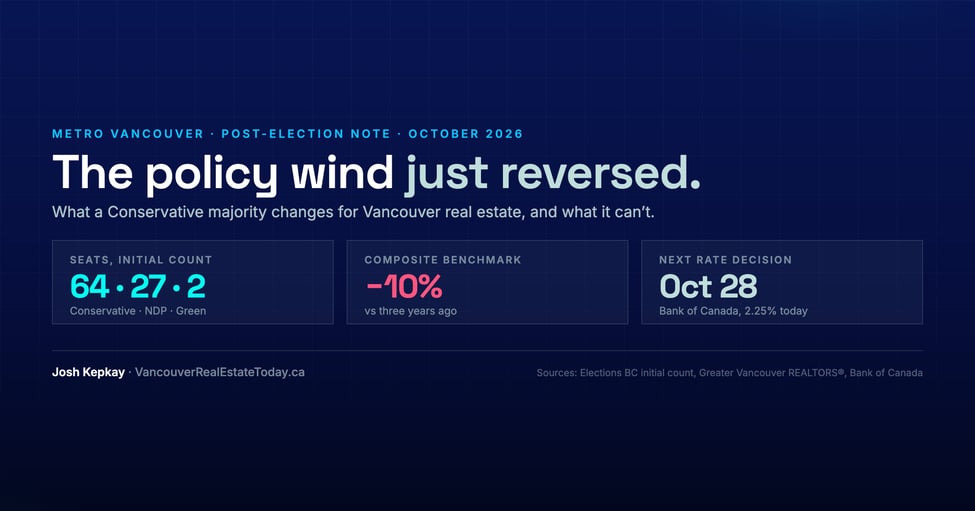
British Columbia elected a Conservative majority on October 24, 2026. On the initial count the Conservatives hold 64 of 93 seats against 27 for the NDP and 2 for the Greens, with about 48% of the vote to the NDP's 37%. It ends almost a decade of NDP rule under John Horgan and David Eby, and Eby resigned as party leader in his concession speech. Lorne Doerkson, the MLA for Cariboo-Chilcotin who became interim leader only two days before the election was called, is premier-designate. The party name is new to government; the governing approach is a throwback. Doerkson was first elected as a BC Liberal in 2020 and crossed the floor in 2024, and the platform reads like that party's sixteen years in office: lower taxes, an open door to capital, and density left to municipalities. Elections BC's final count runs November 6 to 10, so the seat numbers can shift at the margins, but the result cannot.
Two things Doerkson said on election night matter here: a repeat of the promise of no new taxes and no increases, and a line about welcoming capital back to the province. For most of the past decade the message to capital was the opposite.
The policy direction, side by side
Here is what the last government did or proposed, and what the incoming one has committed to. The left column is the record; the right is the platform, which is a promise rather than a law until the legislature sits.
| Issue | NDP record and 2026 platform | Conservative platform |
|---|---|---|
| New taxes | Unsold condo tax proposed September 25; speculation and vacancy tax to double; top income brackets up two points plus a new 24.5% rate above $1 million from 2027 | No new taxes and no increases for the full term |
| Income tax | Lowest bracket raised to 5.6% in Budget 2026; bracket thresholds frozen through 2030 | Basic personal amount raised to $32,000, a cut of about $1,000 a year from 2027 |
| Building costs | Step Code tightened; development charges set locally with provincial targets | Cut construction taxes and charges; overhaul the Step Code; end municipal bans on gas connections |
| Approvals | Provincial housing targets and density orders over municipalities | Approvals in months; density decisions returned to local governments and their community plans |
| Existing property taxes | Speculation and vacancy tax, foreign buyer tax, flipping tax, additional school tax above $3 million | Keeps the speculation and vacancy tax and the foreign buyer tax; silent on the flipping and school taxes |
| Rent | Rent increases capped at 2.2% for 2027 | No stated change |
Sources: the Conservative platform as compiled by BC Ballot, the NDP releases during the campaign, and Budget 2026.
Three caveats. The Conservatives never said what happens to the unsold condo tax, because it was never law; a government that has promised no new taxes will not introduce one, but that is my reading rather than their statement. Keeping the speculation and vacancy tax means the landlord maths changes less than the headlines suggest. And none of the building-cost promises carry a dollar figure or a date yet. This is a change of direction, and it is a long way from finished policy.
What the election cannot do
It cannot move the Bank of Canada. The Bank decides on Wednesday, October 28, with its policy rate at 2.25% after eight straight holds. September's inflation came in at 3.1%, driven almost entirely by gasoline, with the core measures at 1.8% and 1.9%, and after that print the market leaned toward a hike, with Reuters putting the odds near 80%, while RBC, TD, and most of the mortgage economists I read still expect a hold. Either way, the five-year Government of Canada bond that prices fixed mortgages sits at 3.50% as of October 22, up from 3.06% in early July, and the best insured five-year fixed rate is 4.34%. Money is not getting cheaper this year.
It cannot bring back the condo investor on its own. Vancouver asking rents have been down year over year for 34 straight months, the 2027 rent cap is 2.2%, and the maths that pushed the investor out over the past two years is the same maths this week. That is why apartment sales fell 18.6% in September while detached sales rose. A new government changes the tax on that owner; it does not change the rent cheque.
It cannot clear the inventory. CMHC counted 4,376 finished, unsold condos across the region in May, up 76% in a year, and the developer carrying them still has a lender setting the floor on price.
Why sentiment moves before prices
Housing markets are expectation machines. The buyer who waits for prices to rise is really waiting for the feeling that prices are about to rise, and that feeling arrives in a crowd. We saw it in reverse over the past two years: every tax announcement and every rate hike was a reason to wait, waiting became the consensus, and consensus became the market. September sales ran 25% below the ten-year average, and 85% of the homes that did sell in my three areas went for less than asking.
What changed on Saturday is the headline flow. The next six months bring a new cabinet, a throne speech, a budget, and a run of announcements about capital, approvals, and construction costs, each of which will be reported as good news for real estate whether or not it moves a single price. Add a possible rate cut in 2027 if inflation outside energy keeps running under 2%, and the story the market tells itself flips from "why would I buy now" to "why didn't I buy then." I have watched that flip in this city before. It happens faster than anyone plans for.
Where the market stands today
From the September data, the most recent we have: the Greater Vancouver composite benchmark is $1,075,900, down 5.5% on the year, 10% below three years ago, and roughly 3% below January in every segment. The sales-to-active ratio is 10.9%, with 16,394 homes for sale. In my three areas, 37% of new listings in the month to October 9 were relists of homes pulled earlier, 84% of them cheaper, and the median sale closed at 97% of list. That is a buyer's market in every column, and nothing in it says prices rise next month. What it says is that the price did a lot of adjusting while the policy pointed the wrong way, and the policy just turned.
What I'd do
If you're moving up. This is the best stretch of the cycle for you, and it is time-limited. When prices fall 10%, the home you are buying loses more dollars than the one you are selling, and when 85% of deals close below ask, you negotiate on both ends. Sell what you have and buy what you're moving to in the same quiet market, before the first run of good headlines puts competition back in the room.
If you own an investment property and have been waiting to get back to even. Put two numbers side by side: what waiting costs you each month, and what a realistic recovery returns over the time it would take. For some owners that maths says hold, and I'll tell you so. For many it says the waiting is more expensive than the loss.
If you're buying your first home. You are negotiating with sellers who have had two years of bad news and no competition. That is a position, and it doesn't last. Get a rate hold before Wednesday, decide fixed versus variable on the assumption that the next move is up, and ask for the full listing history on every home you see.
Three dates to watch
October 28: the Bank of Canada's rate decision and Monetary Policy Report. November 3: the US midterm elections, where the forecasting markets have Democrats at roughly 90% to take the House and about 63% for the Senate, which would put a check on the trade policy that has weighed on Canadian confidence all year. November 6 to 10: Elections BC's final count, after which the new government is sworn in and we start to hear which promises come first.
Frequently asked questions
Will the BC Conservatives cancel the unsold condo tax? It was never enacted; it was an NDP campaign proposal from September 25. The Conservatives have pledged no new taxes and no increases for their full term, so there is no path for it to become law under this government. They have said they will keep the existing speculation and vacancy tax and the foreign buyer tax.
Is now a good time to sell a home in Vancouver? If you are selling to buy something bigger, yes: the dollar gap between the two homes is smaller when prices are lower, and both sides of the trade are negotiable. If you are selling to leave the market, it depends on your timeline; prices are about 10% below three years ago and the policy direction has just turned, which argues for patience if you can afford it.
Will Vancouver home prices go up in 2027? Nobody knows, and the Bank of Canada's path matters more than the provincial government's. What has changed is the balance of risks: the policy risk that pushed prices down for nine years now points the other way, and markets tend to move on that shift before the data confirms it.
Want to know where you stand before the mood changes?
If you'd like a current value for your home, send me the address and I'll come back with a number, no strings. If there's a move in your next chapter, book a strategy session and we'll map every step: the sale, the financing, the purchase, and the timing. You can also reply to the email that brought you here, or call or text 604-313-9805.
Josh Kepkay
Personal Real Estate Corporation
Top 3% of Greater Vancouver Realtors
Medallion Club since 2022
604-313-9805 | Real Broker | [email protected]
www.VancouverRealEstateToday.ca
Sources: Elections BC initial count via BC Ballot, October 25, 2026; The Canadian Press election-night coverage; Conservative Party of BC platform and BC NDP campaign releases as compiled by BC Ballot; Greater Vancouver REALTORS September 2026 statistics and area reports; MLS hotsheet activity for North Vancouver, Vancouver East, and Vancouver West, September 16 to October 9, 2026; Bank of Canada; Statistics Canada September CPI; Rentals.ca; CMHC; Kalshi midterm markets as of October 16. Market commentary reflects general observation and is not financial, tax, legal, or voting advice.