
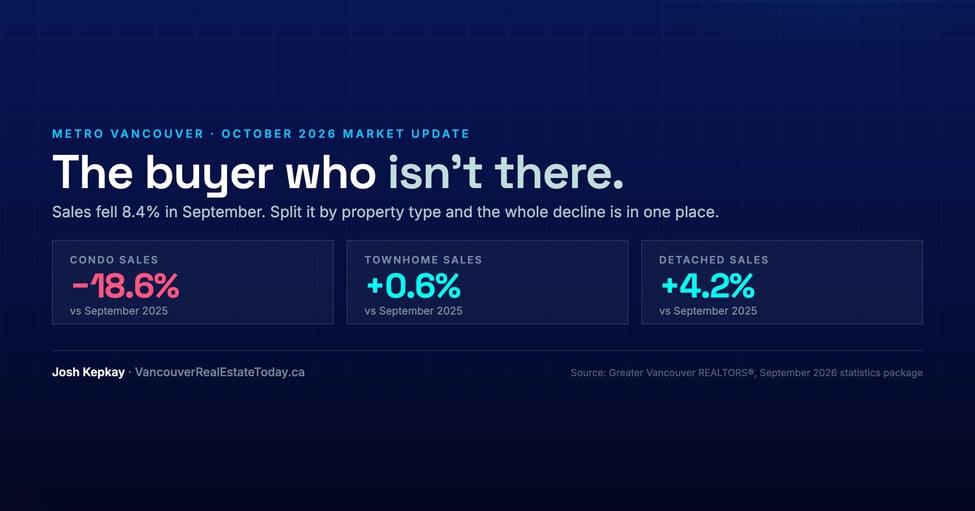
Who is actually buying homes in Metro Vancouver right now? End-users. In September 2026, apartment sales across Greater Vancouver fell 18.6% while detached sales rose 4.2%. The investor who used to buy condos has stepped back, and families buying houses are carrying the market.
Happy Thanksgiving, and happy election season. With two weeks to go before the provincial vote, the NDP campaign has a villain, and it's a condo. CMHC counted 4,376 finished, unsold condos across the region in May, up 76% in a year, so on September 25 the party proposed a tax on any newly completed condo that stays unsold for more than a year: 2% of assessed value, climbing a point for every year it sits, plus a higher speculation and vacancy tax. The pitch writes itself. Developers are hoarding. People need homes. Make them sell.
I want to take that seriously, because it isn't crazy and a lot of people believe it. I also think it gets the story backwards, and September's numbers show why.
Home sales across Greater Vancouver fell 8.4% in September, to 1,717, a quarter below the ten-year average for the month. Detached house sales rose 4.2%. Townhomes rose 0.6%. Every bit of the decline was condos, down 18.6%, and in North Vancouver condo sales fell by nearly half while house sales rose 20%. A market only does that when one particular buyer stops showing up.
Both elections are covered further down, with links to each municipality's candidate pages: city councils vote on Saturday, October 17, and the province on Saturday, October 24. The market first.
Who is actually buying?
End-users, mostly. The Greater Vancouver REALTORS' own economist said as much in the September release: end-users are driving this market, and investor demand is waiting for better conditions.
In the three areas I track most closely you can watch it happen. Condo sales fell 47.5% in North Vancouver and 39.6% in Vancouver East. Detached sales rose 20.4% and 14.0% in the same two places.
The buyer who's gone is the investor who bought a one-bedroom to rent out, and you can see why. Asking rents in Vancouver have now fallen, year over year, for 34 straight months. The provincial rent cap for 2027 is 2.2%. The maths stopped working, so they stopped coming. Families still need houses. Investors don't need condos.
That is the whole story of the unsold condo, and it is the key to the election.
The strongest case for the unsold condo tax
The strongest version of the case goes like this, and it isn't crazy. A tax raises the cost of waiting. Some developers who are holding out for a better market would cut prices sooner. More supply at lower prices, sooner. If the inventory were being hoarded, it would work.
Where I think it goes wrong
Those condos are empty because their buyer left, whatever the campaign says about hoarding, and developers are already paying interest, property tax, insurance, and strata fees on every one of them.
Most can't simply slash the price either. The lender behind a project typically sets a floor, often around 90 to 95% of the prices written into the loan agreement, below which the bank has to sign off on each sale. Stack a tax on top of that and you still have no buyer. You have more projects heading toward the lender, and a clear message to the next developer not to start.
The sequence it belongs to
Here's the pattern worth noticing, because the condo tax is one step in a sequence, and the sequence is the point. Rent increases have been capped at 2%, 3.5%, 3%, 2.3%, and now 2.2% a year since 2023. A provincial flipping tax arrived in January 2025. The speculation and vacancy tax is slated to double. The additional school tax on homes over $3 million rises in 2027. Each of those made it less worthwhile to own a home you don't live in, which in a condo tower is another way of saying it made it less worthwhile to be a landlord. The investor left. Asking rents have been down for 34 straight months. And the campaign's explanation for the empty condos is that the people who own them are hoarding, so the remedy is to tax them for not selling.
The step after that is the one nobody campaigns on. In a few years, when fewer people want to own a rental or build one, the shortage comes back, and the public ends up buying the inventory. That part has already started. In June, Ottawa and Victoria announced a plan to buy more than 2,200 vacant condos, worth about $1.45 billion, and offer them rent-to-own at prices below what they cost to build. The details were promised for the fall. None have arrived. I don't think anyone designed it this way. It reads as a sequence anyway, and for anyone keeping count, a Vancouver home now carries the property transfer tax, a 20% foreign buyer surcharge, the speculation and vacancy tax, the city's empty homes tax, the additional school tax above $3 million, the provincial flipping tax, the federal flipping rule, GST on new construction, and the annual property tax. The campaign's reading of September is that the missing ingredient is one more.
The fair reply
I should be fair to the other side. If you believe the industry will never cut prices on its own, the tax at least forces the question. Some of what got built is product nobody wanted at any price: small suites designed for an investor who no longer exists, and a reckoning on that stock is coming either way. And falling rents and fewer investors in the bidding are exactly what renters and first-time buyers were promised.
The disagreement is about whether a tax speeds a healthy adjustment or deepens an unhealthy one. I lean toward the second, and I'd be happy to be wrong. But the thing that will decide what your home is worth next spring is missing from both ballots. It's the cost of money, and it moved the wrong way over the summer. First, the rest of the ballot.
What the rest of the ballot says about housing
On October 4 the NDP added an income tax increase to its platform: the top two brackets rise two points in 2027, to 18.8% on income above $190,405 and 22.5% above $265,545, with a new 24.5% rate above $1 million, worth about $1 billion a year. That lands on top of a budget that already raised the lowest bracket from 5.06% to 5.6% and froze the bracket thresholds through 2030, so inflation does the rest.
The Conservatives have pledged no new taxes and a $1,000 income tax cut, and as of this writing have not published a housing platform. The Greens want vacancy control, which ties rent to the unit rather than the tenant, in a city where rents are already falling.
So the housing choice this month is, roughly: tax the inventory, say nothing about it, or regulate a price that is dropping on its own. I don't say that to be glib. I say it because none of the three starts from the question of who is actually buying.
There is a reason the province is reaching for revenue. The deficit for this fiscal year is $13.8 billion, a record, and BC's credit rating has been cut eight times since 2023. That matters for housing because the province's borrowing costs, and its appetite for spending on things like non-market housing, run through the same bond market that sets your mortgage rate.
The part that will outlast both elections: the cost of money
On September 16 the US Federal Reserve raised its rate for the first time since 2023 and signalled another increase this year. The Bank of Canada held at 2.25% on September 2 and meets again on October 28. After September's job losses, markets have stopped expecting a hike this month, but they still expect one in December.
The five-year Government of Canada bond, which prices your fixed mortgage, was 3.06% at the start of July and 3.60% on October 8. The best insured five-year fixed rate was under 4% in late July and is 4.34% as I write. RBC and BMO raised fixed rates again on October 7.
The honest answer about money is that it is not getting cheaper this year, and for 2027 the risk has shifted toward rates going up. I said over the summer that waiting for a rate cut was a bet. Three months later the odds have moved against it, and the people who took variable rates because a cut felt inevitable are the ones I'd call first.
Two things are true at once, and I'd hold both. Money costs more than it did, and prices have kept drifting down. Every segment in the region is now about 3% lower than it was in January, and the composite benchmark is 10% below where it was three years ago. For an end-user with a down payment and a five-year horizon, that combination is unusual. It is the first autumn in a long while where the price has done a lot of the adjusting before the buyer walks in.
That's the backdrop. Here's September.
September 2026 by the numbers
Metro Vancouver, September 2026, per the Greater Vancouver REALTORS stats package:
| Measure | September 2026 | Context |
|---|---|---|
| Residential sales | 1,717 | Down 8.4% on the year; 25% below the ten-year average |
| Apartment sales | 777 | Down 18.6% (detached up 4.2%, townhomes up 0.6%) |
| New listings | 5,852 | Down 10.3% on the year |
| Active listings | 16,394 | Down 4% on the year; 24.3% above the ten-year average |
| Sales-to-active ratio | 10.9% | Detached 9.7%, townhomes 12.2%, apartments 11.4% |
| Composite benchmark | $1,075,900 | Down 0.5% on the month, 5.5% on the year |
Detached benchmark $1,784,700. Townhomes $1,016,700. Condos $682,500. The GVR's read is that slow sales and falling inventory have kept prices from dropping quickly, and that the small monthly declines have added up.
North Vancouver, Vancouver East, and Vancouver West
The nine local segments, from the September area reports. Under 12% on the ratio pressures prices down; over 20% pressures them up.
| Area | Type | Benchmark | vs last year | Sales-to-active | Days to sell |
|---|---|---|---|---|---|
| North Vancouver | Detached | $2,042,000 | down 6.2% | 15.3% | 36 |
| North Vancouver | Townhome | $1,230,400 | down 4.9% | 13.5% | 31 |
| North Vancouver | Condo | $769,000 | down 3.2% | 8.7% | 35 |
| Vancouver East | Detached | $1,630,500 | down 7.7% | 9.4% | 37 |
| Vancouver East | Townhome | $980,400 | down 7.9% | 9.2% | 47 |
| Vancouver East | Condo | $634,800 | down 5.2% | 11.1% | 46 |
| Vancouver West | Detached | $2,916,100 | down 8.7% | 6.6% | 37 |
| Vancouver West | Townhome | $1,298,500 | down 5.5% | 8.6% | 43 |
| Vancouver West | Condo | $761,800 | down 5.2% | 12.9% | 40 |
North Vancouver is the clearest picture of the missing buyer. Detached sales rose 20.4% on the year to 59, and the sales-to-active ratio climbed to 15.3%, the highest of the nine segments and the only one that rose from August. Condo sales fell 47.5% to 42, and the condo ratio dropped to 8.7%. The detached benchmark gave back August's gain, down 2.2% on the month, but the sales mix is the signal: between $2 million and $3 million, 28 homes sold against 161 listings, roughly six months of supply. Above $4 million, none sold against 27. Lynn Valley had the most detached sales of any neighbourhood, nine, and Lynn Valley townhomes were the only North Vancouver segment with a benchmark higher than a year ago, up 2.8%.
Vancouver East was the one major area in the region where the composite benchmark rose in September, up 0.7%, with detached up 0.6% and condos up 1.0% on the month. I'd read that carefully. It comes after the steepest six-month declines of the three areas for both houses and condos, so some of it is the price finally finding buyers. Detached sales rose 14.0% to 65, and the average house sold in 37 days against 46 a year ago. The condo side tells the other story: sales down 39.6% to 61, a ratio of 11.1%, and 46 days to sell. Mount Pleasant alone had 24 of those 61 sales against 122 listings.
Vancouver West is where the missing buyer is most expensive. Detached sales fell 14.3% on the year to 48, against 729 homes for sale, a 6.6% ratio, the lowest of the nine. And yet the houses that did sell went in 37 days, two weeks faster than last September. Read those together: the buyers who are there know their number, and the listings priced to it move. The rest sit. 45% of the detached inventory on the Westside is asking $4 million or more, and that band produced 11 sales in September. Condos were the surprise: sales down just 4.5% at 214, the ratio at 12.9%, and inventory down 18.5% to 1,655, the biggest drop in supply of any segment I track.
Two things that didn't make the headlines
August's turn didn't hold. In August, four of the nine local segments rose on the month. In September, two did, both in Vancouver East, and the four August risers all fell back. One month isn't a trend, but East Van is where I'd look first for a floor.
The top of the Westside has more than four years of supply. Four detached homes sold above $5 million in September, against 214 for sale. The $2 million to $3 million band, by contrast, had 22 sales against 172 listings, about eight months. The further up the ladder you go, the more the buyer is missing.
The relist tax, one month on
Last month I introduced what I've been calling the relist tax: a seller pulls a listing, waits, and relists it lower, paying in weeks, in price, and in what every watching buyer now knows about their motivation. I said I'd keep tracking it. Here is the update, from MLS hotsheet activity across North Vancouver, Vancouver East, and Vancouver West between September 16 and October 9, matched by address.
1,793 homes were newly listed across the three areas. 1,312 were pulled: terminated, expired, or cancel-protected. 669 sold and 614 went pending.
Of the 1,793 new listings, 667 were the same address as one of the pulled ones. That is 37.2%, essentially unchanged from 38% in early September. 84% of those came back cheaper, and the median cut was 4.2%. Vancouver East had the highest relist share at 40%. Attached homes relisted more often than detached, 38% against 34%.
Two things did change. Pulled-per-sold fell to about two from three and a half, which means more sellers are getting to the finish line instead of the exit. And the cuts got slightly smaller: 644 price changes in the period, 93% of them reductions, with a median cut of 3.8%.
One more number, because buyers ask me about it every week. Of the 669 sales, 85% closed below the asking price. The median sale was 97% of list. So the typical negotiation in this market right now is about 3%.
What I'd do with all of this
If you're selling: the buyer who is there is an end-user, and end-users buy the whole package: the right price band, a home that is ready, and a listing that doesn't look tired. Price to the last sixty days in your band on day one; the relist data says four in ten sellers are still paying for not doing that. If you own a resale condo, the proposed condo tax doesn't apply to you, but it could push developers to discount new units harder in the spring, and that is your competition. The one segment I'd describe as firm is North Vancouver detached between $2 million and $3 million. Everywhere else, plan for six to eight weeks and a negotiation of about 3%.
If you're buying: get a rate hold now. The Bank of Canada meets on October 28 and again on December 9, and the market is pricing a hike at the second one; a hold protects you against that and costs nothing. Make the fixed-versus-variable decision on the assumption that the next move is up, because that is what the bond market is assuming. Then use the data: ask for the full listing history on every home, because 37% of what you'll see this month has been for sale before, and the median sale is settling 3% below asking. If you're buying a condo, you're negotiating in the segment with the least competition. If you're buying a house in North Vancouver, you aren't.
Where you have the least room: North Van detached at 15.3%. Where you have the most: Westside detached at 6.6%, Westside townhomes at 8.6%, and North Van condos at 8.7%.
The municipal votes on October 17
City of North Vancouver. Mayor Linda Buchanan is seeking a third term on her housing record. Of the challengers, Dave Kurvers is campaigning on family-sized apartment design and faster, more predictable approvals, Mike McGraw wants infrastructure planned before new density is approved, and Oliver King has not published a platform.
District of North Vancouver. Mayor Mike Little is also seeking a third term. The District had approved 832 homes against a provincial target of 2,838 at last count, and in April council declined a provincial request for more small-scale multi-unit housing. Housing targets are the live issue, along with the roughly $3 billion overrun on the North Shore wastewater plant. The challengers are Stephan Nieweler, Max Zahedi, Graham Alexander, and Paolo Pucci. Every candidate in both municipalities, with their filed statements sorted by issue, is at northvanvotes.ca, an independent, non-partisan guide. You vote in one of the two, depending on where you live.
West Vancouver. Mayor Mark Sager faces Kirk LaPointe, Sharon Thompson, and Joe Spears. West Van approved 58 homes against a provincial target of 220, and in April the province ordered the District to put its own shelved Ambleside Centre plan into effect. Dates, places, and profiles: election.westvancouver.ca.
Vancouver. Mayor Ken Sim (ABC) is running for a second term on a second property tax freeze and a promise to speed up permits further. Councillor Pete Fry (Green), who has led in two polls, is promising pre-approved building designs, faster low-rise permitting, and lifting the city's pause on new supportive housing. Kareem Allam (Vancouver Liberals), Sim's former chief of staff, would merge the city's twelve approving departments into one and adopt the BC Building Code in place of Vancouver's own. Councillor Rebecca Bligh (Vote Vancouver) is running on permanently affordable homes for middle-income earners on public land. Colleen Hardwick (TEAM) would repeal the citywide Vancouver Plan bylaw and the Broadway Plan. For anyone who owns or wants to own here, the permitting and plan questions matter more than the tax one: they decide how much gets built, and where, over the next four years. All eight mayoral candidates, the voter's guide, and voting places are at vancouver.ca. The last advance voting day is Tuesday, October 13.
For the provincial election on October 24, advance voting runs October 16 to 21, vote-by-mail requests are due October 18, and registration and voting places are at Elections BC.
The simple version
The market's problem this autumn is that one kind of buyer left, and the policies on offer are mostly arguing about the inventory that buyer left behind. For everyone else, the maths got a little worse on the financing side over the summer and a little better on the price side. And the segments where real buyers are present, houses between $2 million and $3 million in North Vancouver, a firming benchmark in East Van, Westside condos where sales held and supply fell 18%, are not the ones the campaigns are talking about.
Frequently asked questions
Is now a good time to buy a condo in Vancouver? If you're buying to live in it, you're negotiating in the segment with the least competition: apartment sales fell 18.6% in September 2026, the composite condo benchmark is $682,500, and 85% of recent sales closed below asking. If you're buying to rent it out, the numbers are harder, because Vancouver asking rents have fallen year over year for 34 straight months and the 2027 rent cap is 2.2%.
What is BC's proposed unsold condo tax? Announced by the NDP on September 25, 2026, it would apply to newly completed strata condos left unsold for more than a year, at 2% of assessed value in the first year and rising one point each additional year. It would not apply to resale condos. No start date, cap, or exemptions had been published as of October 10.
Will Canadian mortgage rates go up in 2026? Fixed rates already have. The five-year Government of Canada bond rose from 3.06% in early July to 3.60% by October 8, and the best insured five-year fixed rate moved from under 4% to 4.34%. The Bank of Canada held its policy rate at 2.25% on September 2; markets expect it to hold on October 28 and price a hike in December.
Want to know what your place would do in this market?
That conversation takes about half an hour. Tell me your area and your property type and I'll walk you through the band you're in: book a call or coffee chat, or call or text 604-313-9805. If you'd rather start with a number, request a home value review.
Josh Kepkay
Personal Real Estate Corporation
Top 3% of Greater Vancouver Realtors
Medallion Club since 2022
604-313-9805 | Real Broker | [email protected]
www.VancouverRealEstateToday.ca
Sources: Greater Vancouver REALTORS September 2026 statistics package and area reports; MLS hotsheet activity for North Vancouver, Vancouver East, and Vancouver West, September 16 to October 9, 2026; Bank of Canada; US Federal Reserve; Rentals.ca National Rent Report, October 2026; CMHC via Business in Vancouver; BC Ministry of Finance First Quarterly Report, September 2026; BC NDP, Conservative Party of BC, and BC Green Party platform releases; Elections BC and municipal election pages. Market commentary reflects general observation and is not financial, tax, legal, or voting advice.